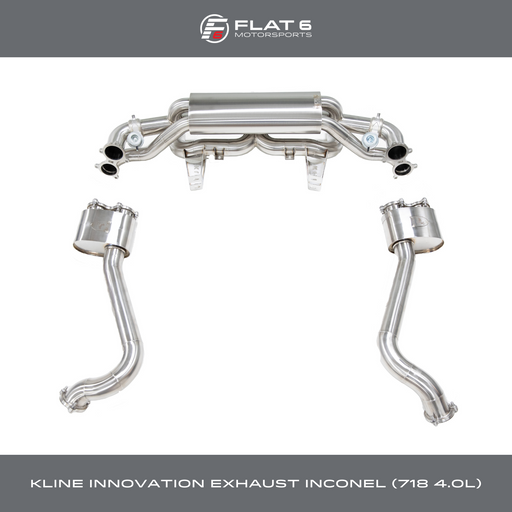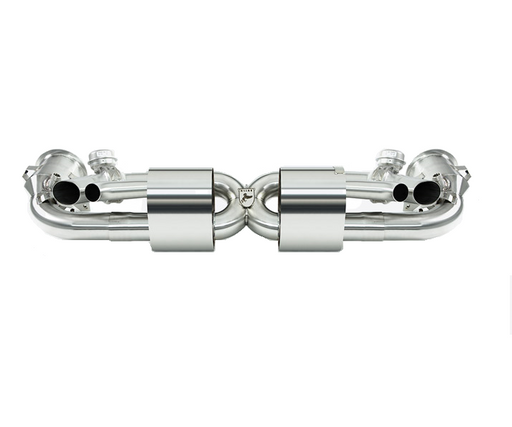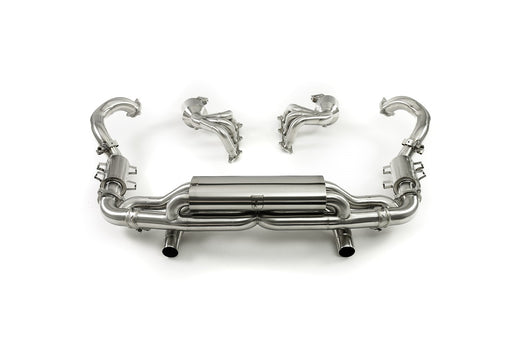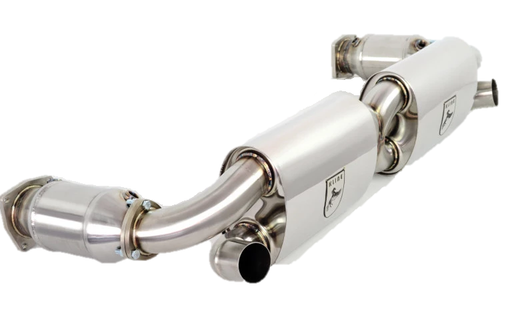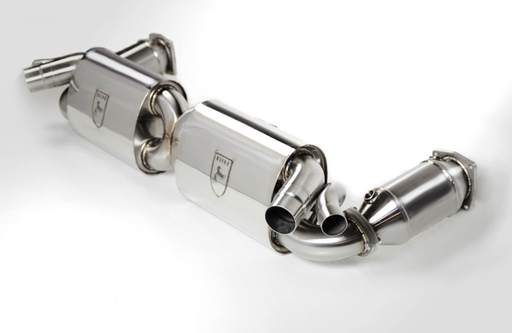


Kline Innovation Header Set (981 Base / S / GTS / GT4 / Spyder)
Designed to fit
- 2013-2016 Porsche Cayman Base / S / GTS / GT4
- 2013-2016 Porsche Boxster Base / S / GTS / Spyder
Product Details
Precision-built from premium materials and tailored specifically for the 981 flat-six engine the Kline Innovation Stainless Steel or lightweight Inconel system enhances both performance and perfect sound—making it a favorite among enthusiasts seeking a perfect blend of race-inspired performance and refined German engineering.
THE SOUND
Building on our highly revered Porsche turbo range, we have incorporated many of the same design features into our Cayman R, 1D CLR X pipe for that incendiary howl at higher rpm, harmonically tuned silencers, and ultra-thin Inconel 625 for that “Unique to Kline” sound.
Available in Decat for optimum sound and performance or a 200 cell high flow sports cats.
Features
- Full Inconel or Stainless Steel Material
- Extremely Lightweight System
Weight
Manifolds 4kg each
Inconel 625
Manifolds DECAT 2.3kg each
About Kline Innovation

Kline Innovation is a Bucharest, Romania based exotic exhaust manufacturer who utilizes exotic materials to innovate high-end systems for Porsche, Ferrari, Lamborghini, Aston Martin, Audi, Bentley and McLaren. At Kline they take exhaust design very seriously. Consumers demand a no compromise product, and they take a no compromise approach to design and manufacture.
MATERIALS
At Kline Innovation they believe in the absolute best materials for every application, chosen scientifically by the materials natural properties. Titanium/Inconel/Carbon fiber exhaust boutique, they also offer 304 stainless steel as an alternative on their complete range. Every material has its own unique properties, and perfect application based on weight, strength, heat resistance, and chemical stability. Kline strives to craft some of the world’s best lightweight exhausts utilizing every innovation possible!
The following is a brief overview and explanation of the different materials they use, properties, and functions.
INCONEL
Inconel 625 is used in the aerospace industry where extremely durable and heat withstanding components are required. As an example, Inconel is used for the exhaust turbine blades in high performance jet engines. Inconel is used for the manufacture of formula one exhausts, and has also been used by some manufacturers on hypercar projects such as the Mcalren P1, Aston Martin 177, where lightness is a factor, and exhaust temperatures regularly exceed 1800 degrees fahrenheit.
The basic properties of Inconel are characterized by extremely high tensile strength, and extreme thermos-chemical stability. Due to the high tensile strength of Inconel (roughly the same strength to weight ratio as titanium), very thin sidewall material can be used, while still maintaining structural integrity, resulting in very light weight components that will not fatigue over time. The main drawbacks to using Inconel, is that it’s extremely difficult to machine and weld, and requires a high degree of skill and involves a time consuming processes. It’s also extremely expensive as a raw material.
TITANIUM
Titanium in its varying grades is commonly used in a variety of applications where strength to weight ratio is paramount. Very high tensile strength and low density mean that very light and strong components can be manufactured easily. Titanium is also relatively easy to machine and weld using standard engineering approaches. The main disadvantages to titanium, is the cost of material, and prolonged heat exposure exceeding 1100 degrees fahrenheit causes oxidation of the material, resulting in brittle components and potential breakages. For this reason titanium is best suited to cooler applications where strength and lightness is a factor.
STAINLESS 304
Stainless steel 304 grade has become the industry standard for exhaust manufacturing. It’s moderate strength, thermos-chemical stability, inexpensive, and easy to manufacture. 304 stainless can be used to build relatively inexpensive exhausts to a high standard of functionality and durability. The main drawback to stainless steel is the weight. Roughly the same density of steel, but reduced tensile strength, building high performance exhaust components from stainless can be limited. Also from the perspective of sound, the thick sidewall required from stainless, can produce a slightly dull lackluster sounding exhaust note when compared to the previously mentioned materials!
CARBON FIBER
Carbon fiber reinforced polymer has an extremely high tensile strength to weight ratio, surpassing that of all metals. Extremely light weight components can be molded to almost any shape. The main drawback to carbon fiber being, the material cost, the fatigue endurance limit is hard to define (the material can break unexpectedly), and the lack of prolonged heat resistance due to the polymer binding agent.